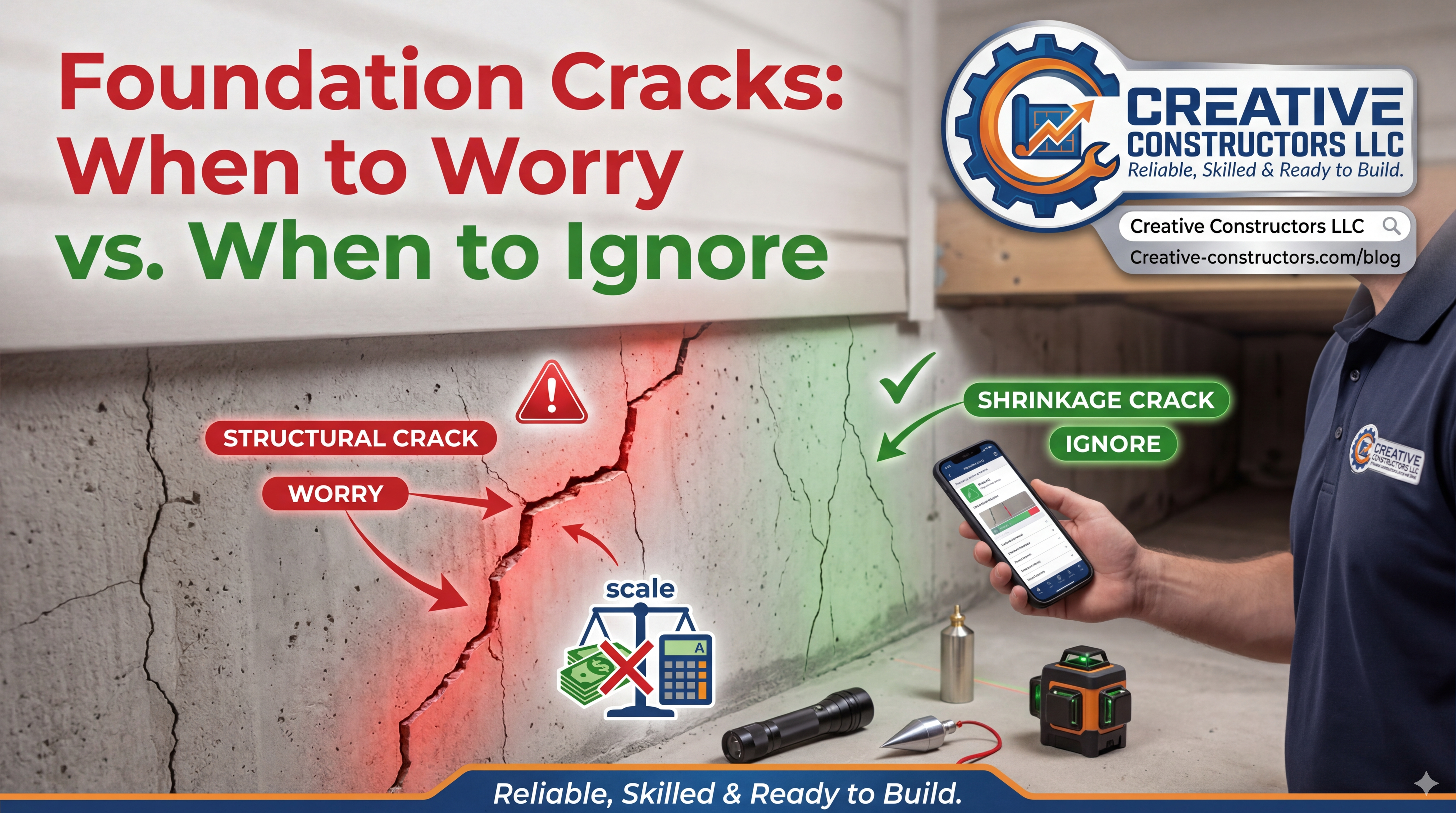
Not every foundation crack means trouble — but some do. Here's how to tell the difference as a DFW homeowner, and when it's time to call a pro.
If you own a home in the DFW area, you've probably noticed a crack in your foundation at some point. Maybe you spotted it during a routine walk-around, or maybe a neighbor mentioned something. Either way, that moment of "uh oh" sets in fast.
Here's the truth: not every foundation crack is a disaster. Some are completely normal. But some are a real warning sign that needs attention before it turns into a major — and expensive — problem. Growing up working on job sites and custom home builds, I learned early that knowing the difference is half the battle.
Let's break it down so you know exactly what you're looking at.
Why DFW homes crack more than most
North Texas soil is notorious for its high clay content. That clay expands when it's wet and shrinks when it dries out — which means your foundation is constantly being pushed and pulled depending on the season and how much rain we've had. Add in our summer heat and the occasional drought, and it's no wonder foundation movement is practically a rite of passage for DFW homeowners.
This doesn't mean every crack is a crisis. It means you need to know what type of crack you're dealing with.
The cracks you can probably ignore
Most hairline cracks — thin as a credit card or smaller — are the result of normal concrete curing and settling. They're extremely common in new construction and older homes alike. If the crack is horizontal and very shallow, or runs vertically in a straight line with no displacement on either side, it's typically just the concrete doing what concrete does.
The cracks you can probably ignore
Most hairline cracks — thin as a credit card or smaller — are the result of normal concrete curing and settling. They're extremely common in new construction and older homes alike. If the crack runs vertically in a straight line with no displacement on either side, it's typically just the concrete doing what concrete does.
Cracks that are generally okay: hairline vertical cracks, anything under 1/8 inch wide, cracks where both sides sit flush with each other, cracks that haven't changed in size, and cracks that are dry with no water getting through.
The cracks that need attention
Cracks that warrant a professional look: horizontal cracks in block or poured concrete walls, stair-step cracking in brick, anything wider than 1/4 inch, cracks where one side sits higher than the other, and any crack letting in water or bugs.
The cracks that need attention
Horizontal cracks — especially in block or poured concrete walls — are a red flag. They can indicate lateral soil pressure pushing against your foundation, which is a structural concern. Stair-step cracking that follows the mortar joints in a brick foundation is another one to watch. If you're seeing diagonal cracks that radiate from the corners of windows or doors, that's often a sign of differential settling — meaning one part of your foundation is moving more than another.
Width matters too. A crack you can slip a quarter into (1/4 inch or more) deserves professional eyes. And if you notice that a crack has grown since you last looked at it — take a photo, mark the ends with a pencil and date it — that's a sign something is actively moving.
Pro tip: Mark the ends of any crack you're monitoring with a pencil and write the date next to it. Check back in 30 and 60 days. If it's growing, that's your cue to call someone.
What about water getting in?
Any crack that's allowing water intrusion needs to be addressed — even if it's small. Water is patient. It will find every gap, erode the surrounding material, and eventually turn a minor crack into a major one. In our DFW climate with the freeze-thaw cycles we get in winter, that water expands inside the crack and makes it worse over time.
A crack letting in water isn't just a foundation issue — it's a moisture issue for your whole crawl space or basement, which can lead to mold, wood rot, and pest problems.
So when should you call a pro?
If you're seeing any of the warning signs in the list above — horizontal cracking, displacement, cracks wider than 1/4 inch, or water intrusion — get a professional assessment. A good contractor will tell you honestly whether it needs repair, monitoring, or nothing at all. Be cautious of anyone who immediately pushes a $15,000 solution without explaining what's actually happening.
At Creative Constructors, we scope foundation crack repairs honestly. Sometimes the fix is a simple epoxy injection. Sometimes it's carbon fiber straps. Sometimes we tell you to just keep an eye on it. You deserve a straight answer — not a sales pitch.
Got a crack you're not sure about? We serve homeowners across the DFW area — reach out and we'll take a look.