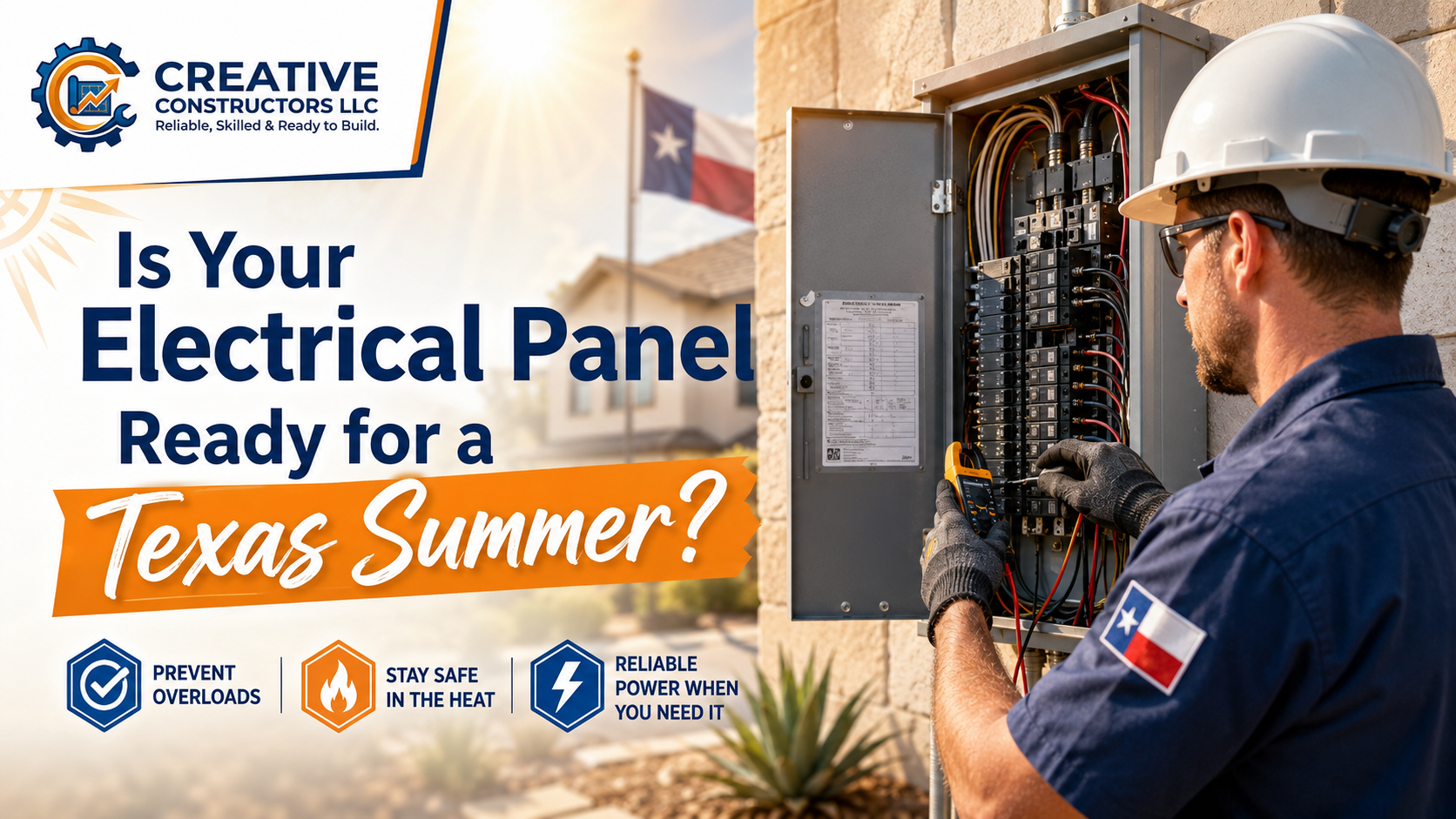
Texas summers push your electrical panel to its limits. Here's what to check before the heat hits — before a tripped breaker leaves you sweating at midnight.
Every June, we get a surge of calls from homeowners in University Park, Highland Park, and the Park Cities with the same problem: their air conditioner tripped a breaker — again — and now half the house is dark. Sometimes it's a nuisance. Sometimes it's a fire hazard.
A Texas summer is brutal on your electrical system. When it's 105°F outside and your AC is running eight, ten, twelve hours a day, your panel is working harder than it was ever designed to work. If your home is older than 20 years and you haven't had your panel inspected, you're rolling the dice.
Here's what I look for when a homeowner calls me about electrical issues before summer hits.
Check Your Breaker Panel for Warning Signs
Walk to your main electrical panel — usually in a utility room, garage, or hallway — and open it up. You're looking for a few things:
What to check: Are any breakers in the "tripped" position (halfway between on and off)? Do you see any rust, corrosion, or burn marks inside the panel? Do any breakers feel warm to the touch when the AC is running? Is there a burning or electrical smell?
Any of those is a red flag. A breaker that trips repeatedly isn't doing its job anymore — it's wearing out, and a worn breaker can fail to trip when it should, which is when fires happen.
If your panel is from the 1970s or 80s, also check the brand. Federal Pacific Electric (Stab-Lok) and Zinsco panels have well-documented failure problems and should be replaced regardless of condition. I see them regularly in older Park Cities homes, and I never leave without flagging it.
Know Your Panel's Amperage
Most homes built before 1980 have 100-amp service. Modern homes — especially those with electric HVAC, EV chargers, or large appliances — typically need 200 amps.
What to check: Look at the main breaker at the top of your panel. It'll be labeled 100A, 150A, or 200A. If you're running a 4-ton AC unit, an electric dryer, a dishwasher, and a couple of refrigerators all at once in 104-degree heat, a 100-amp panel is often not enough.
Signs you're regularly overloading: lights dimming when the AC kicks on, breakers tripping under normal use, or outlets that feel warm. That's not normal. That's your system telling you it's maxed out.
An electrical panel upgrade — moving from 100A to 200A service — typically runs $1,500 to $3,000 depending on what's involved. It's one of the better investments you can make in an older home, and it'll also increase your home's value and insurability.
Inspect Your GFCI and AFCI Breakers
If your panel was installed before 2000, you probably don't have Arc Fault Circuit Interrupter (AFCI) breakers in your bedrooms. Modern code requires them for good reason — AFCI breakers detect the specific electrical signature of an arc fault, which is the kind of hidden wiring issue that starts house fires inside walls.
What to check: AFCI breakers have a TEST button on the breaker itself. If your panel has standard breakers in bedroom circuits, that's worth addressing. Same goes for GFCI protection — if your outdoor outlets, garage, and bathrooms aren't GFCI-protected, you're not up to current code.
This isn't just a code compliance issue. In the Park Cities, we see a lot of 1950s–70s homes that have been renovated multiple times by multiple contractors over the decades. Hidden wiring problems are common. AFCI breakers are a real safety net — and they're not expensive to add.
Check Your Outdoor Outlets and Panel Clearance
Summer means more outdoor activity — power washers, outdoor fans, extension cords for string lights and outdoor kitchens. Your outdoor outlets take a beating this time of year.
What to check: Make sure outdoor outlets have weatherproof covers in good condition. Test them with a GFCI outlet tester (about $10 at any hardware store). If they don't trip when tested, they need to be replaced.
Also check the clearance around your panel. The NEC requires 36 inches of clear space in front of any electrical panel. Homeowners often end up stacking storage in front of their panel over the winter. Clear it out — in an emergency, you need to get to that panel fast.
Consider a Whole-Home Surge Protector
Texas summers mean thunderstorms, and thunderstorms mean power surges. Every HVAC system, refrigerator, and smart home device in your house is vulnerable — and the power strips on your entertainment center aren't going to save your AC compressor.
Point-of-use surge protectors do some work, but they don't protect hardwired appliances like your AC unit, water heater, or dishwasher. A whole-home surge protector installs directly at your main panel and protects everything in the house.
What to do: Have a licensed electrician install a service entrance surge protector. These typically run $300–$600 installed. For the protection they provide to appliances that together cost tens of thousands of dollars, it's cheap insurance. I recommend them to every homeowner I work with in DFW.
When to Call a Pro
If you found any of the following during your inspection, don't wait: burn marks, rust, or corrosion inside the panel; a breaker that trips repeatedly on the same circuit; warm or hot outlets or breakers; a Federal Pacific or Zinsco panel brand; 100-amp service with modern electrical demand; or no AFCI protection in sleeping areas.
These aren't DIY fixes. Electrical panel work requires a licensed electrician and, in Texas, a permit and inspection. It's not the place to cut corners — the consequences of getting it wrong are fire, not just inconvenience.
At Creative Constructors, we handle electrical panel inspections, upgrades, and repairs throughout the Park Cities, University Park, and Highland Park. We're licensed, permitted, and we show up when we say we will. If your panel needs attention before summer hits, give us a call — don't wait until you're sweating it out at midnight with a tripped breaker.