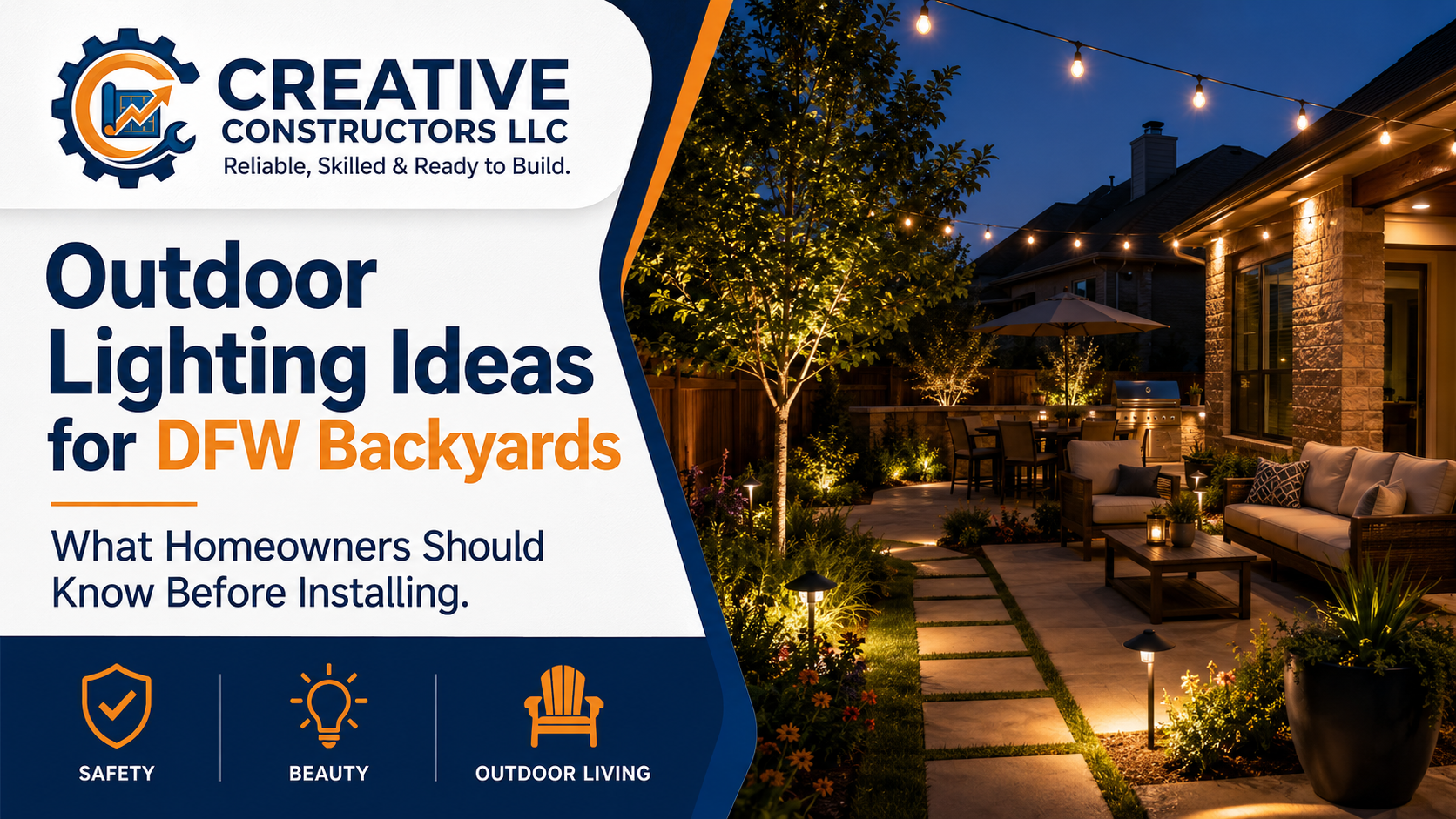
Outdoor lighting can make your backyard safer, more useful, and better looking — but only when it is installed correctly. Here is what DFW homeowners should know before adding patio lights, landscape lighting, pathway lights, or security lighting.
Outdoor Lighting Ideas for DFW Backyards: What Homeowners Should Know Before Installing
Outdoor lighting is one of those upgrades that can completely change how a backyard feels. A dark patio becomes usable. A plain fence line gets some depth. Walkways become safer. The front of the home looks more polished. And when it is done right, outdoor lighting makes the whole property feel more finished.
But there is a big difference between adding a few cheap solar lights from the store and installing outdoor lighting that actually works, lasts, and looks good.
For DFW homeowners, outdoor lighting has to deal with Texas heat, storms, wind, moisture, clay soil movement, pests, irrigation overspray, and plenty of year-round use. That means the plan matters. The products matter. And the installation definitely matters.
Here is what homeowners should know before adding patio lighting, landscape lighting, pathway lighting, security lights, or backyard accent lighting.
Why Outdoor Lighting Matters for DFW Homes
In Dallas–Fort Worth, outdoor spaces are not just for looks. A lot of homeowners use their patios, decks, outdoor kitchens, pools, and backyards for entertaining, grilling, relaxing, and spending time with family.
The problem is that many homes were not built with enough exterior lighting for how people actually use their outdoor spaces today.
You may have one porch light by the back door, maybe a floodlight on the corner, and that is about it. That might technically light up the yard, but it usually does not create a comfortable outdoor living space.
Good outdoor lighting can help with:
Safer walkways and steps
Better patio and deck visibility
Improved curb appeal
More usable outdoor space after dark
Better security around doors, gates, and driveways
Highlighting landscaping, trees, fences, and architectural features
Reducing dark spots around the home
The goal is not to make your backyard look like a gas station parking lot. Nobody wants that. The goal is controlled, layered lighting that makes the space safer and more enjoyable without blasting your neighbors’ windows like a police helicopter.
Start With How You Actually Use the Space
Before choosing fixtures, start with the real question: how do you use the outdoor area?
A backyard used mainly for grilling needs different lighting than one used for entertaining guests. A pool area needs different lighting than a side yard with a gate. A front walkway needs different lighting than a covered patio.
Think through the areas where people actually walk, sit, cook, gather, or need visibility.
Common outdoor lighting zones include:
Back patios
Decks
Pergolas
Outdoor kitchens
Pool areas
Walkways
Driveways
Side yards
Gates
Fence lines
Garden beds
Front entries
Garage areas
Once you know the zones, it becomes easier to choose the right type of lighting for each area.
Patio Lighting: Make the Space Usable, Not Harsh
Patio lighting should feel warm, comfortable, and practical. This is where people sit, talk, eat, and relax, so the lighting should not be overly bright or cold.
Good patio lighting options include:
Wall-mounted sconces
Ceiling-mounted outdoor fixtures
Recessed lights in covered patios
Pendant lights over outdoor dining areas
String lights under pergolas or across seating areas
Low-voltage accent lighting around patio edges
For covered patios, hardwired lighting is usually the cleanest option. It looks better, works reliably, and can often be controlled from a switch, dimmer, timer, or smart lighting system.
String lights can look great too, but they need to be installed properly. The biggest mistake homeowners make is hanging them from weak anchor points, stretching them too tightly, or relying on extension cords as a permanent setup. That might work for one weekend, but it is not a long-term outdoor electrical plan.
Pathway Lighting: Safety First, Looks Second
Pathway lights are one of the most practical outdoor lighting upgrades. They help people see where they are walking, reduce trip hazards, and make the yard feel more finished.
Pathway lighting works well along:
Front walks
Sidewalks
Garden paths
Pool paths
Steps
Driveway edges
Side yards
Gate access paths
The key is spacing. Too few lights and the path still has dark gaps. Too many lights and it starts to look like an airport runway. A good layout gives enough visibility without overdoing it.
Low-voltage pathway lighting is common for this type of setup. It is efficient, flexible, and easier to adjust than line-voltage fixtures. That said, transformers, wire routing, connections, and fixture placement still need to be handled correctly if you want the system to last.
Landscape Lighting: Highlight the Best Parts of the Yard
Landscape lighting is where outdoor lighting starts to feel custom. Instead of only lighting the areas where people walk, landscape lighting highlights the features that make the yard look good.
This can include:
Trees
Flower beds
Stonework
Retaining walls
Fountains
Outdoor fireplaces
Fence lines
Columns
Architectural details
Uplighting a tree, for example, can add a lot of depth to a backyard. Lighting along a fence can make the space feel larger. Accent lighting around stonework or planters can make a simple yard feel more high-end.
The trick is restraint. You do not need to light every shrub like it is on stage at a concert. Pick the features that matter and let the rest stay subtle.
Security Lighting: Bright Enough Without Being Annoying
Security lighting has a different job than patio or landscape lighting. It is there to improve visibility and reduce dark areas around doors, driveways, garages, and side yards.
Common security lighting options include:
Motion-activated floodlights
Wall-mounted exterior lights
Garage lights
Side-yard lights
Gate lights
Smart security lights with cameras
Motion lights are useful, but placement matters. If they are aimed wrong, they can shine directly into windows, annoy neighbors, or trigger constantly from trees, cars, or animals.
A good security lighting plan should cover the important areas without turning the whole property into a spotlight zone.
For many homes, the best setup is a mix of low-level ambient lighting and targeted motion lighting in key areas.
Outdoor Lighting and Electrical Safety
This is the part homeowners should not ignore.
Outdoor lighting is exposed to weather, water, pests, soil movement, and physical damage. That makes proper installation important.
Outdoor electrical work may involve:
Weather-rated fixtures
GFCI protection
Proper exterior-rated boxes and covers
Correct wire type
Proper conduit or burial depth where needed
Safe transformer installation
Secure connections
Correct load calculations
Switch, timer, or smart control setup
This is not the place to “make it work” with indoor-rated parts, open splices, loose cords, or random connections tucked behind a bush. That kind of setup might work for a little while, but outdoor conditions will expose bad work quickly.
If lighting is being hardwired, added to an existing circuit, installed near water, or connected to controls, it is smart to have a qualified professional handle it.
Solar Lights vs. Low-Voltage Lighting vs. Hardwired Lighting
Homeowners usually look at three main options: solar, low-voltage, and hardwired lighting.
Solar Lighting
Solar lights are the easiest to install and can be useful for basic accent lighting. They are usually inexpensive and do not require wiring.
The downside is performance. Many solar lights are not very bright, do not last as long, and depend heavily on sun exposure. In shaded yards or after cloudy weather, they may not perform well.
Solar lights are fine for temporary or decorative use, but they are not usually the best choice for serious pathway, security, or patio lighting.
Low-Voltage Lighting
Low-voltage lighting is one of the best options for landscape and pathway lighting. It uses a transformer to reduce the voltage and power multiple fixtures around the yard.
Low-voltage systems are commonly used for:
Path lights
Tree uplights
Garden bed lighting
Accent lighting
Fence line lighting
This type of system gives a more professional look than solar and is usually more reliable. It still needs proper planning, quality connections, correct transformer sizing, and good wire routing.
Hardwired Lighting
Hardwired lighting is typically used for permanent fixtures such as patio lights, sconces, ceiling lights, floodlights, and exterior wall lights.
This is usually the cleanest and most reliable option for areas where you need switched lighting, smart controls, or stronger illumination.
Hardwired lighting should be installed by someone who understands outdoor electrical safety, weather protection, and proper code-compliant methods.
Smart Outdoor Lighting Controls
Smart lighting is becoming more common in DFW homes, especially for homeowners who already use smart thermostats, security cameras, or home automation systems.
Smart outdoor lighting can allow you to:
Schedule lights automatically
Control lights from your phone
Use dusk-to-dawn settings
Add motion-based triggers
Create scenes for entertaining
Integrate lighting with security systems
This can be a great upgrade, but the system needs to be planned correctly. Outdoor Wi-Fi coverage, switch compatibility, fixture type, and control locations all matter.
For example, a smart switch may work great for patio sconces, while a low-voltage transformer with a timer or smart plug may be better for landscape lighting. It depends on the setup.
Common Outdoor Lighting Mistakes
A lot of outdoor lighting problems come from poor planning or cheap installation shortcuts.
Common mistakes include:
Using indoor-rated fixtures outside
Relying on extension cords permanently
Installing lights where irrigation constantly sprays them
Overloading existing circuits
Poor wire connections
Bad fixture spacing
Lights aimed into windows
Too much brightness
Not enough lighting at steps or transitions
No GFCI protection where needed
Cheap fixtures that fail quickly in Texas weather
The biggest mistake is treating outdoor lighting like decoration only. It is partly decorative, yes, but it is also an exterior electrical system. It needs to be safe, durable, and practical.
What Homeowners Can Safely Check Themselves
There are a few things homeowners can safely do before calling someone out.
You can walk the property at night and look for:
Dark walkways
Poorly lit steps
Dark side yards
Gates that are hard to see
Patio areas that feel too dim
Existing fixtures that flicker
Lights that trip GFCI outlets
Damaged fixture covers
Exposed wiring
Rusted or loose fixtures
Extension cords being used outdoors long-term
You can also take photos of the areas you want improved. Night photos are especially helpful because they show where the lighting problems actually are.
For simple solar lights, homeowners can usually install those themselves. Just understand they are more decorative than professional-grade.
What Should Be Handled by a Professional
Call a professional if the project involves:
New hardwired exterior fixtures
Adding switches
Running new outdoor wiring
Installing lighting near pools or water features
Repairing damaged exterior wiring
Troubleshooting tripping GFCI outlets
Replacing failed exterior electrical boxes
Installing floodlights or camera lights
Adding smart lighting controls
Connecting lighting to an existing circuit
Any electrical work you are not completely sure about
Outdoor electrical work is not the place to guess. Water and electricity are already a spicy combo, and not in the fun taco kind of way.
Planning a Better Outdoor Lighting Layout
A good lighting layout usually has layers.
Think of it like this:
Safety Lighting
This includes steps, paths, walkways, and places where people move around.
Task Lighting
This includes grill areas, outdoor kitchens, dining areas, and work zones.
Accent Lighting
This includes trees, landscaping, stonework, and architectural features.
Security Lighting
This includes driveways, garages, doors, gates, and side yards.
When these layers work together, the yard feels balanced. You get visibility where you need it, atmosphere where you want it, and security where it matters.
Best Outdoor Lighting Ideas for DFW Homes
Here are a few outdoor lighting upgrades that make sense for many DFW homes:
1. Pathway Lights Along Front Walks
This improves curb appeal and makes the entrance safer for guests.
2. Warm Patio Sconces
Outdoor sconces can make a patio or back entry feel more finished without being too bright.
3. Tree Uplighting
This adds depth and makes the backyard feel more custom, especially in larger yards.
4. Step Lights for Decks and Patios
Any elevation change needs visibility. Step lighting is both practical and sharp-looking.
5. Motion Lights on Side Yards
Side yards are often dark and forgotten. Motion lights can help with visibility and security.
6. Lighting Around Gates
A gate light makes it easier to access trash areas, side yards, pool equipment, and service paths.
7. Smart Timers or Dusk-to-Dawn Controls
Automatic controls help keep the lighting useful without requiring you to remember to flip switches every night.
When to Call Creative Constructors
If your backyard, patio, fence line, or outdoor walkway feels too dark, Creative Constructors can help you figure out a practical outdoor lighting plan that fits how you actually use the space.
We can help with exterior lighting upgrades, patio lighting, pathway lighting, smart lighting controls, fixture replacement, outdoor electrical troubleshooting, and general outdoor living improvements.
Small outdoor upgrades can make a big difference, especially when the layout is planned correctly from the start.
Call or text Creative Constructors at (817) 470-1889 or visit creative-constructors.com to schedule service.
Final Thoughts
Outdoor lighting is one of the best upgrades for making a backyard more useful, safer, and better looking. But the best results come from planning the layout before buying fixtures or running wire.
Start with the areas you use most. Light the walkways and steps first. Add comfort lighting around patios and seating areas. Use accent lighting sparingly. And when electrical work is involved, get it installed correctly.
A good outdoor lighting setup should not feel random. It should feel like the home was meant to be used that way all along.