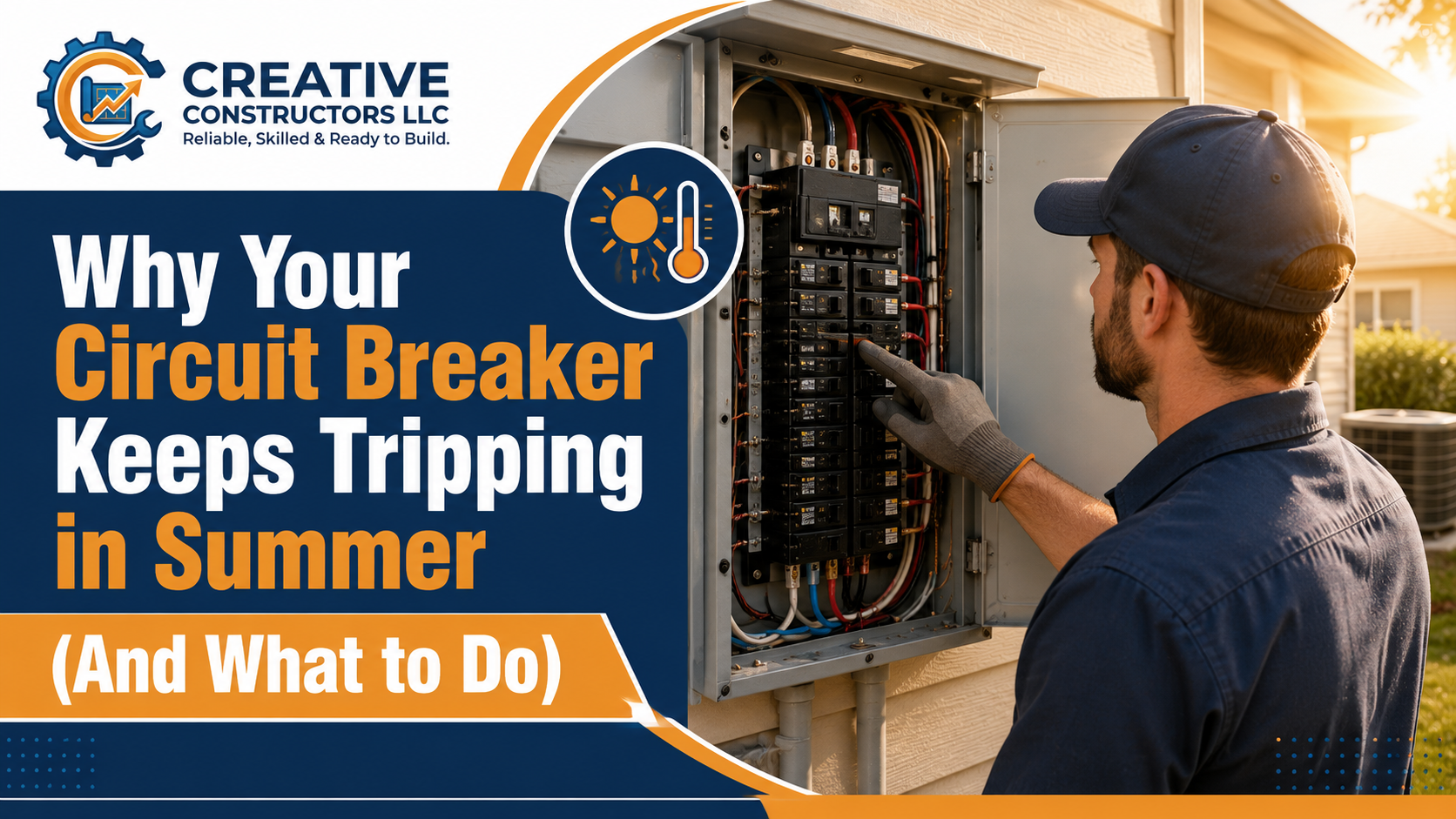
Circuit breaker tripping every summer? Here's what's actually causing it and what to do — from a licensed DFW electrician who's seen it all.
If your breaker trips every summer — usually right when the AC kicks on, or when you're running the microwave and a few other things at once — you're not imagining it. Summer is the absolute worst time of year for circuit overloads in North Texas, and I see this constantly at homes throughout the Park Cities, University Park, and Highland Park area.
Here's the good news: most breaker trips are your panel doing exactly what it's supposed to do. The bad news: when it keeps happening, it usually means something in your electrical system needs attention. Let me walk you through the most common reasons your breaker keeps tripping in summer and what to actually do about each one.
Why Breakers Trip More in Summer
What to understand first: A breaker trips when a circuit is trying to carry more current (amps) than it was designed to handle. In summer, demand on your home's electrical system spikes — air conditioners pull heavy loads, outdoor refrigerators run constantly, and everyone's charging devices, running fans, and cooking more. That's a lot of demand stacked on circuits sized for normal use.
Dallas-Fort Worth summers are no joke. When it's 105°F outside, your AC isn't cycling on and off — it's running almost continuously. A central AC unit can draw 15–20 amps all by itself. If your home is older or the panel hasn't been updated, that kind of sustained load is right at the edge of what the system was built for.
Reason 1: Overloaded Circuit
This is the most common cause. You've got too many things drawing power from the same circuit.
What to check: What was running when the breaker tripped? Write it down. If it's always the same combination — AC + microwave, or bedroom circuit + window unit — you've got an overload. Look at what else is on that circuit. Outlets, lights, and appliances in the same room or zone often share a circuit. Compare what you're plugging in now versus what was normal when the house was built. A 1970s home wasn't wired for today's appliance load.
What to do: Stop resetting and plugging everything back in the same way — you'll just trip it again. Redistribute the load and move high-draw appliances to different circuits if possible. If it's a recurring problem, call an electrician to add a dedicated circuit for the high-draw device. This is especially common with AC units, EV chargers, and home offices.
Reason 2: AC Unit Drawing Too Much at Startup
Air conditioners have a startup surge — the moment the compressor kicks on, it draws 2–3x its normal running current for a second or two. On older panels or circuits that are already near capacity, that surge trips the breaker.
What to check: Does the breaker trip specifically when the AC comes on, not while it's running? That's a startup surge issue. When was your AC last serviced? A dirty condenser coil or low refrigerant forces the compressor to work harder — drawing more current on startup. Check the breaker size vs. the AC's required amperage on the data plate on the outdoor unit.
What to do: Get the AC serviced. A clean, properly charged unit starts up easier. If the breaker is the right size but still tripping at startup, the compressor may be hard starting — a hard-start capacitor kit can sometimes fix this for a few hundred dollars. If the wiring or breaker is undersized for the unit, an electrician needs to correct that.
Reason 3: The Breaker Itself Is Worn Out
Breakers aren't forever. They're mechanical devices rated for a certain number of trips. After years of use — and especially after repeated overloads — breakers can start tripping at lower loads than they should.
What to check: How old is your panel? If it's 20–30+ years old, worn breakers are a real possibility. Does the breaker trip on a very light load — like just turning on a light — with nothing else running? Does it trip and then not reset cleanly, or feel loose in the panel?
What to do: Don't keep resetting a breaker that trips at light loads — that's a sign it's no longer functioning correctly. A licensed electrician can test and replace it if needed. Breaker replacement is usually $100–$250 for the part and labor. Also note: some brands like Federal Pacific and Zinsco have known reliability issues and should be evaluated by an electrician regardless of current symptoms.
Reason 4: A Failing Appliance or Short Circuit
A device that's developing a fault — a motor going bad, damaged wiring inside an appliance, a fraying cord — can draw excessive current and trip breakers repeatedly.
What to check: Unplug everything on the circuit and reset the breaker. If it holds, plug devices back in one at a time until it trips again — that's your culprit. Look for obvious signs: burning smell, outlets that are warm to the touch, or discoloration around outlet covers. If the breaker trips immediately when reset with nothing plugged in, you may have a short circuit in the wiring itself, not a device.
What to do: Replace or stop using the faulty device. If the short is in the wiring — not a device — do not keep resetting the breaker. Call an electrician. A wiring short left unaddressed is a fire hazard.
When to Call an Electrician
If any of these apply, don't wait: the breaker trips immediately when reset with nothing running; you see or smell burning at the panel, outlets, or any device; the breaker is warm or hot to the touch; you're resetting the same breaker more than once a week; or your panel is 25+ years old and you're having recurring issues.
I've been doing electrical work in University Park, Highland Park, and across the Park Cities long enough to say this plainly: a circuit breaker tripping is a warning. It's working as designed. The bigger risk is when homeowners rig around it — swapping a 15-amp breaker for a 20-amp one to stop the tripping — and remove the protection the breaker is there to provide.
If your breaker keeps tripping this summer and you can't get to the bottom of it with the steps above, Creative Constructors is here. We're a licensed electrical contractor serving Park Cities, University Park, Highland Park, and the surrounding DFW area. Give us a call and we'll diagnose it the right way.